
This excerpt
is from Chapter 12 of
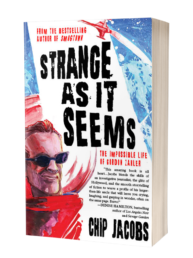
Wheeling the Deal:
The Outrageous Legend of Gordon Zahler, Hollywood's Flashiest Quadriplegic.
Behler Publications. Copyright Chip Jacobs.
This was making it. Buying trips to London and New York. Ed Wood
doubling what he paid last time. A music deal for 195 Crusader
Rabbit cartoons. Watching secretaries who’d once fabricated
excuses why their boss wasn’t in welcome him with a supple, “Good
morning, Mr. Zahler. We’ve been expecting you.”
It was all good, all bizarre evolution,
but he was working such long hours overseeing the edits and stocking
new music that he sometimes broke into unexplained sweats or
felt weak by eleven a.m. Gordon’s head whirled in business twenty hours a day
and his body suffered. Rose badgered him to be careful. “You’re
going to work yourself back into intensive care if you don’t
take it easy,” she would say on the drive home to Shoreham
Drive. CPA Jack had his own opinion. The TV-shooting season was
over, he said. Take a little vacation.
Tell that to the quiver at the base of
Gordon’s skull. Be
content you’re making money, the quiver lectured in
tight situations. Stare in the mirror if you get antsy for
more. Why shouldn’t he look? Existing above the neck,
Gordon felt severed from the thrills that were once his stipulated
daily requirement. No mischief, no speed, no double-dares, no girls.
Paralysis demented him with boredom. Others were in charge of his
every damned wish. By the time they fulfilled it, the new items
he thought of were already green with mold. About the only action
he enjoyed was traveling, which he couldn’t do enough, and
pitching ideas.
Too often, watching the blood drain out
of people’s faces
when they caught site of him for the first time constituted the
dramatic part of his day. Then he’d have to calm them down
by acting casual. If that failed, he found it helpful to repeat
stories about his wild childhood—old stink bomb attacks or
riding bikes off roofs. Their knowing he hadn’t always been
a quadriplegic seemed to offset their shock, though it didn’t
quell the twitch inside them they were one bone-crushing fall away
from being him.
As if the comforting did him much good.
Twenty years of sponge bathing had pancaked expectations. In
that time, there had been two thrill rides and one genuinely
interested woman. The club hopping—that
was adolescent stuff. Now that he was in Hollywood, around soundstage
gunfights and peroxide sex kittens, he saw how frustrating it was
to be numb in a touch-me town.
He wanted to cavort. The Sunset Strip was
right there. He only needed a shove. My grandma said she was
baffled. Why, she asked, couldn’t he be content with what he had accomplished? Everybody
was so proud. “Remember the article (that called him a genius)?” Because,
he said, that wasn’t enough. Watching Milton Berle on TV
in his new house after work left his juices cold. She reminded
him of the fun he had at that costume party, when a friend had
dressed him up as Whistler’s Mother and he took first prize. “Couldn’t
you be satisfied going to a party once a month?” He looked
up at the ceiling, disgusted. “Mom, you haven’t figured
it out, have you? We both know I’m never getting up. But
getting cheated when there’s a lot I can do? If you want
to know the truth, I’d rather be dead.”
Neither of them plied the subject further.
In the silence, Rose thought about what that physician who had
given him a checkup a month ago had predicted. She had called
Dr. Risser at home for a second opinion that night when Gordon
sacked out early. Was it true, she had asked? That he couldn’t possibly live another
five years as the other doctor had told her privately? Depends
on him, Risser had responded. He had never heard of anybody with
a cervical injury like Gordon’s who made it past thirty-five.
An orthopedic journal had already published a story on how surprising
it was he’d lasted.
Ultimately, it was Rose’s mother, the fat, folksy Dearie
Rossman, who bestowed on Gordon the adage he had been waiting to
hear. The occasion was the party for his thirty-third birthday,
and most of the guests had surrounded the coffee urn in the kitchen.
While they were away, Dearie leaned in close and whispered to him
what she told her neurotic pet dachshund. “Don’t strain
yourself. You’re here for pleasure.”
Pleasure. Early one Friday evening, a month
after his birthday, Gordon sat alone in the rear seat of a Chrysler
ragtop gunning along Interstate 10. He was being driven to Palm
Springs, a desert playground 100 miles east of L.A. Samuel Bronston
Jr., the son of one of Gordon’s independent-producer-friends,
was behind the wheel. His actress-girlfriend was nuzzled up close
to him on the front seat. It was to be a relaxing weekend of
poolside card games and indulgent, four-drink dinners. They had
the radio turned up and Sam let everyone pull swigs from his
silver flask. Anybody mentioning business got the evil eye.
Sam Jr., however, was more interested stealing
looks down his girlfriend’s
blouse than concentrating on the one-lane road. He never saw that
rut in the highway, the one about the width of a pizza box. Twenty
miles out of Palm Springs, the Chrysler’s left front wheel
clunked into the hole and the car veered violently off course.
The rut sent it skidding right toward the highway shoulder wholly
out of control. Despite’s Sam feeble attempt to brake, the
car plowed into a dirt mound at about twenty-five mph. The next
sensation was after the crash, when both Sam and his girlfriend
felt the pinch of whiplash in their necks. Here was the other shocker:
Gordon was missing from the back seat.
Night was coming. So was the weekend traffic.
Sam Jr. flashed ahead to what he might be facing—manslaughter charges, his father’s
wrath. This was supposed to be kicks. So many disastrous events
start that way. “Gor-don,” he hollered. “Where
are you? Gordon-don. Where in the name of Christ could you be?”
To be specific, seventeen-and-one-quarter
feet up the highway. Gordon, as he would tell and retell in vivid
reconstructions, wasn’t
in the backseat because he’d been launched out of it. Sir
Isaac Newton could explain it: a body in motion tends to stay in
motion. The moment the car slammed into the embankment, there was
nothing restraining Gordon, certainly not any car seatbelt, which
wasn’t standard then, or his own scrawny body mass.
He was jettisoned, catapulted like flaming ammo during the Crusades,
probably a foot over the door-lock if he had to wager. Along the
way, he blacked out. He remembered nothing about being airborne
or the landing. His memory reset when a car close to where he landed
tore by. That was because he saw it from the tires up and assumed
he was dead.
Actually, lying face down on the asphalt he was sure he was dead.
He wasn’t just on the asphalt—he was just outside the
narrow, white line separating forty mph oncoming traffic from the
shoulder. The light wasn’t terrific for motorists, either.
Twilight speckled the desert in amber hues and deceiving shadows.
Pointed northwest, Gordon could see what was coming towards him.
And a large set of headlights, possibly from a big rig a half-mile
away, was coming. Whatever it was, the headlights shone a lot brighter
now.
“Help,” he called out.
“But where are you?” Sam whimpered. “Jesus. I killed Gordon.
I can’t believe it. I fucking killed him.”
The headlights wound around a little bend and then caught Gordon
150 yards away.
“Over here!” Gordon shrieked, his voice cracking on the vowels. “I’m
over here. Near the white line. And hurry up. I’m begging
ya.”
Sam ran over and scooped him up in his
arms. His passenger was royally peeved. “Nice driving, Sam,” Gordon said. “Five
more inches over the line and a car would’ve squished my
head like a grapefruit.”
The marvel was that he hadn’t shattered his fused spine on
impact and died like road kill. Incredibly, his neck was undamaged.
His face was okay, too, if you excluded the purple knot engorging
out of his left temple. It wasn’t until Sam laid him in the
car that Gordon said he was feeling lousy. He was nauseous, and
it had something to do with his arm. It’d spasmed. Sam said
hold on. He backed the Chrysler out and floored it east on Route
10. This time his girlfriend sat in the rear with Gordon.
At Torney General Hospital near Palm Springs,
Gordon suspected his arm was fractured and said so. The E.R.
doctor, a freckled young man not long out of medical school,
was skeptical a quad could detect limb damage. His hunch was
that the patient was woozy from a minor concussion. “Just grab my elbow and pull up
if you don’t believe me,” my uncle countered. Ignoring
him, the doctor asked the male attendant to assist him removing
Gordon’s sweater because it kept getting snagged along one
of the sleeves. It came off, and his shirt was bloody along one
inseam.
Seeing what lay underneath, people in the room felt their bile
surge up, everybody that is but Gordon, who was accustomed to medical
drama. This was a new one. The bone in his upper-right arm had
snapped cleanly in two with a compound fracture. The end closest
to his elbow had punctured the skin like a twig poking through
snow. Inside, viscous, yellow bone marrow oozed around the blood.
Suddenly there was a dull thunk behind the examining table.
Gordon asked Sam what happened and Sam said the attendant had taken
one peek at the bone and fainted off in the corner. The doctor
apologized for the incident and then shipped Gordon up to surgery.
A couple days later at work, wearing a
sling over his arm cast, Gordon told Nat that Palm Springs could
wait. He had come up with something even better. A speedboat—that’s
what he needed.